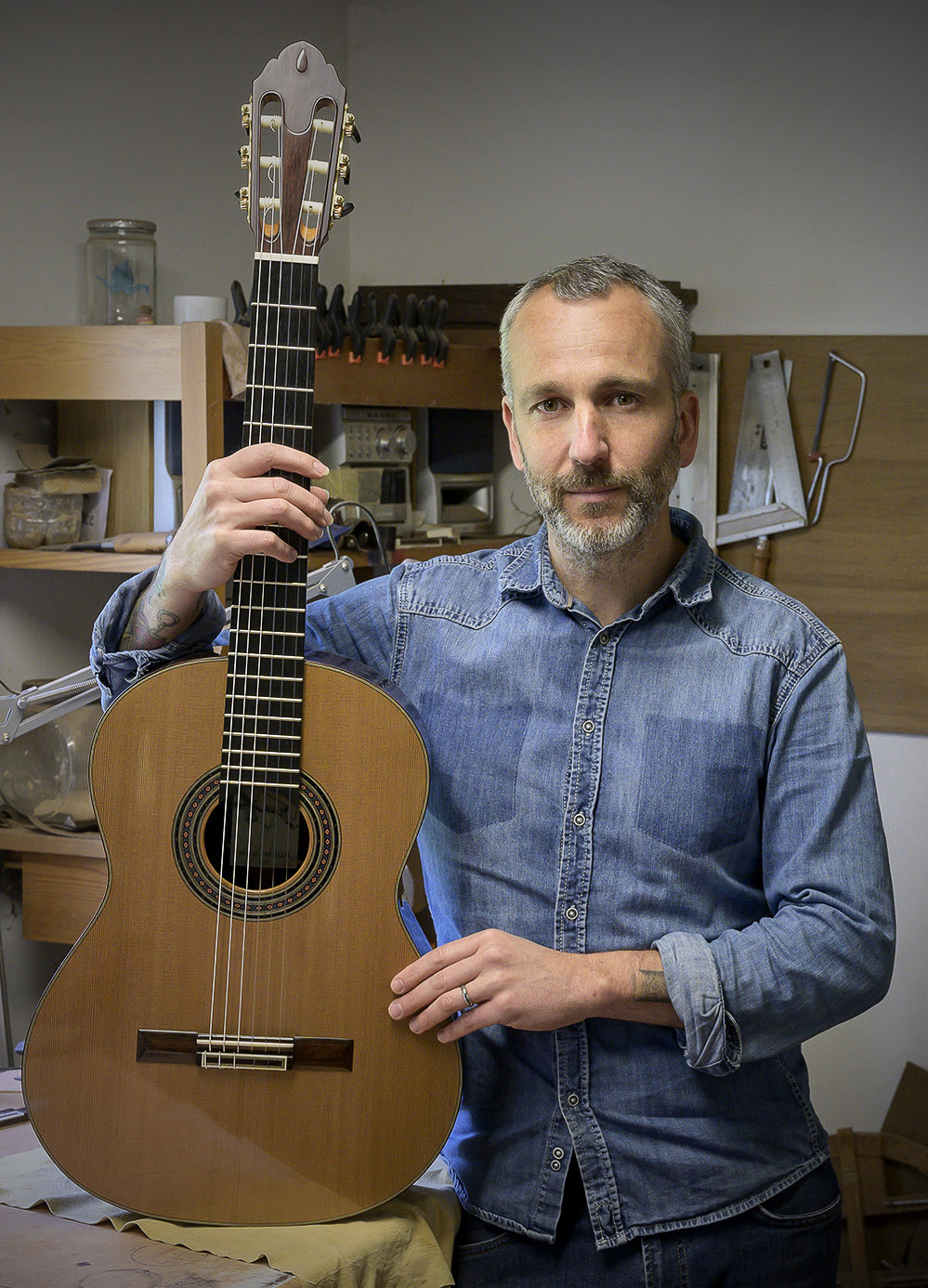
Experience and time...

It's not that easy for a guitar builder to factually measure the real evolution of his art. This is even more true that his instruments live and mature under other skies, far away for their place of birth.
Having had the chance to compare my newest guitars to several previous generations of my own work, I was struck by the fact that the sound balance as perceived by the player, and which used to be somewhat destabilizing, had improved substantially. Moreover, the sound signature is less pianistic than in the past, offering today a personality that is more propitious to interpreting the major pieces which form the milestones of the magnificent repertoire of classical guitar..., whilst retaining the innovation and performance of modern instruments.
This was achieved without any major changes to the design. I can therefore infer that know-how, in its slow maturation, plays a determinant role and that time associated with high construction standards, only erodes remaining roughness to the benefit of a much more complete harmony, than across-the-board technical upheavals.
Evolution takes time and offers, now and then, more thrilling perspectives than revolutionary creative rashes, which can lead to ecstatic but unconvincing outcomes.

The gesture improves, the sound identity asserts itself, the magic operates...

My vision of classical guitar-making today

A "concert-grade" classical guitar should, in my opinion, offer the necessary power, dynamics, and projection for a modern instrument, but should also have a sound that is harmonically-rich and balanced, as well as capable of extensive artistic expression.

Therefore, my approach has been to base my personal research upon a solid heritage and resolutely innovative construction methods and proceed from that starting point, in order to unite these qualities in an instrument dedicated to a musical expression genuinely free of constraints.


My classical guitar dream

As a child, my biggest dream was to take the stage, guitar in hand, and to perform in the most beautiful halls around the world. It's indeed this stubborn desire for excellence that led me to study, years later, at the National Conservatory of Music in Paris, under Roland Dyens's tutelage.

I learned there, thanks to this great master and virtuoso, to "model" the sound in the manner of a sculptor as if it was "musical matter," something of which I am now utterly convinced.

I found in my concert guitar of the time, the "Cathedral" model of Gerard Audirac, some of the characteristics of a "great" concert guitar, which, in my sense, make an instrument in tune with “the spirit of our times" : substance, sound dynamics, tone, sustain, balance of registers, depth and definition of different melodic lines, notwithstanding harmonic density.


My encounter with Gerard Audirac

During that period I met Gerard Audirac, guitar-maker of great talent and at the height of his career. I was soul-searching feeling confused by my paralyzing stage-fright. He made me a surprising and salutary proposition of a guitar-making course, where I built my first guitar. I discovered that I could not only model sound as a performer, but that it was also possible for me to build it with my own hands and to obtain a result I never imagined.

Our relationship has evolved into a friendship over time, thus favoring deep discussions about classical guitar making. He eventually entrusted me with the role of spiritual heir and successor.


The sound I was searching for

The beauty and purity of a sound are undeniably subjective elements, yet its richness, density, harmonic and color palette as well as the quality of its balance and projection, are characteristics that are universally identifiable. If we associate power, dynamics, precision, but also control and sustain, and we package all these into an instrument of modern and innovating expression, we get what represents my actual quest, a perfect concert classical guitar...


My concert classical guitars

Classical guitar making has evolved a lot over these last 40 years. Taking into account the astonishing progress in guitar-playing technique is important in order to give birth to an instrument capable of adapting itself perfectly to the player and his sensitivity, without imposing any constraints in the interpretation of the pieces he chooses. The instrument must allow him to express himself fully and to be heard by the audience whatever the configuration of the hall (small or large) and its acoustics. Also, he must be able to deliver a perfect sound texture for studio recording.

Modern guitar-making has seen the emergence of new technologies such as the "double top" (or "sandwiched-top", utilizing composite materials) or "lattice" bracing, which now offer levels of dynamics and power unheard of a few years back. In parallel to this technological evolution, a more traditional yet still interesting approach continually strives to revisit the old tenets of Torres and Hauser, accepting a more intimate and capricious sound identity which makes its use more difficult in large concert halls.

Although I constantly experiment with new materials and techniques, I currently only use wood in the construction of my guitars. I like to think that this noble material has not yet revealed all of its secrets and I prefer its more "organic" sound.

It is thanks to this original conception, a result of 35 years of research inherited from Gerard Audirac and a thorough knowledge of the needs of a concert guitarist, that I offer a truly innovating instrument, combining beauty and sound richness to the performance of the best modern guitars. I make no compromises on the musicality, authenticity and loyalty to the traditional guitar sound, whilst providing the sensitivity, depth and ease of use that a performer needs today in order to perform every piece of the repertoire from early music to contemporary works.

"Un miracle" by Gérard Audirac

"I love BB" par Roland Dyens